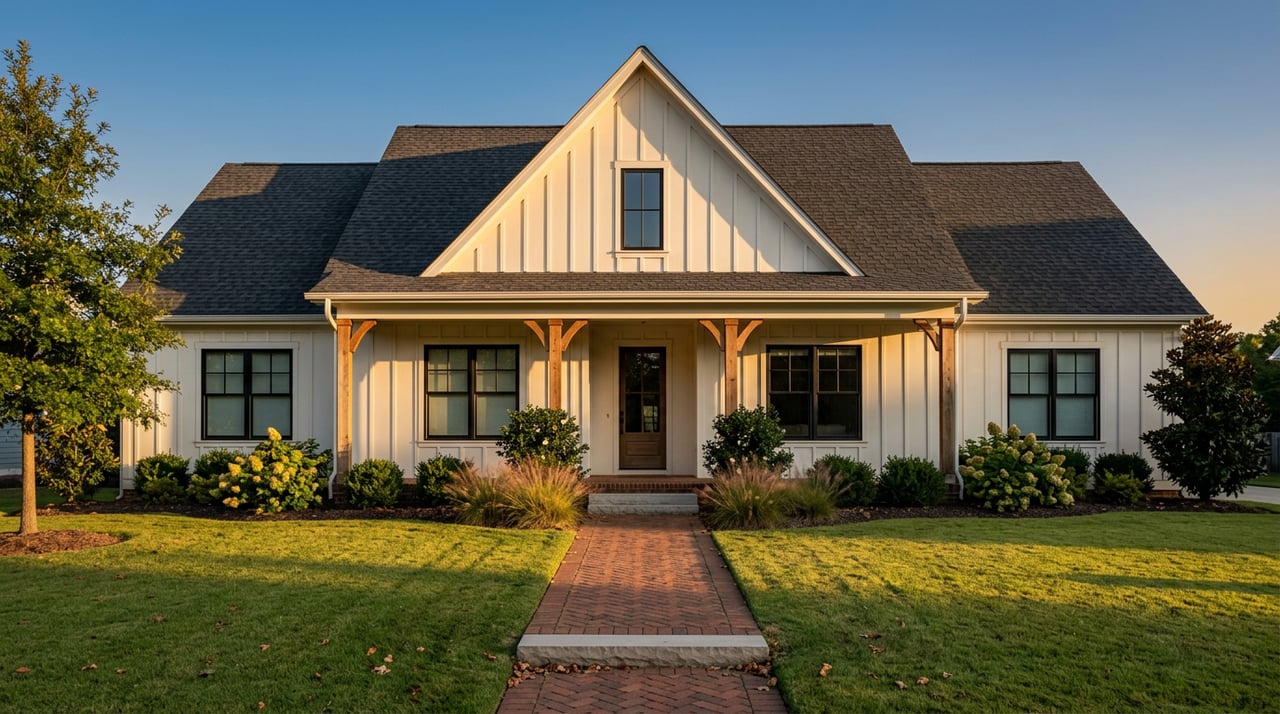
This summer, a three-bedroom house in an established south Durham neighborhood went under contract in eight days, one of more than a third of homes in that pocket that closed above asking price. At almost the same moment, a beautifully kept 1920s bungalow near Duke's East Campus sat on the market for months, waiting for a buyer willing to pay a premium price per square foot for a house with original heart pine floors and a system list that comes with any home built before 1940.
Anyone looking only at Durham’s aggregate figures would miss both stories entirely. The county-level figure that shows up in market reports reads as calm: a median sale price a little over $424,000 for the three months ending July 2026, down 2.3% from a year earlier, with homes selling in a median of 31 days and sellers taking about 1.4% under list price. That's the profile of a balanced market, the kind where neither buyers nor sellers have much leverage.
It's also an average of two markets that are moving in opposite directions. A single county-level median price tells you almost nothing about what happens at the closing table, because which corridor you're buying in changes the entire conversation.
The County-Level Number Is an Average of Two Different Markets
The county-level 31-day, 1.4%-under-list read describes a market where buyers have room to negotiate. That description holds up in some parts of the city and falls apart in others within the same reporting window.
In Hope Valley, homes were selling in a median of eight days, with 36% closing above the asking price, over that same period. That's not a balanced market. That's a market where a well-priced, move-in-ready home draws competition the day it hits the multiple listing service.
Meanwhile, in Trinity Park, the historic in-town neighborhood between downtown Durham and Duke's East Campus, the median sale price over the three months ending in mid-2026 came in near $862,000, a price point where homes tend to sit longer and buyers have more room to negotiate on inspection items and closing costs. Eight miles away, in that same window, an established south Durham neighborhood was clearing sales at a median of $479,833 in eight days.
Same city. Same season. Two entirely different sets of rules for anyone writing an offer.
What $500,000 Actually Buys, Corridor by Corridor
Once you split Durham into its component parts, the question "what does $500,000 buy here?" stops having one answer.
| Corridor | Housing stock | Price per square foot | Typical pace |
|---|---|---|---|
| Trinity Park | Pre-war bungalows and foursquares, 1900s–1940s | Highest in this comparison | Slower, more room to negotiate |
| Hope Valley / Woodcroft | Established single-family, mix of eras | Roughly $243/sq ft in recent sales | Fast, competitive on well-priced listings |
| Southpoint / Parkwood corridor | Newer construction and townhomes | Lower per-foot cost for newer stock | Moderate, varies by product type |
In Hope Valley or Woodcroft, $500,000 at a recent price of roughly $243 per square foot puts a buyer in the neighborhood of 2,000 square feet, in a house with mature landscaping and a shorter drive to Research Triangle Park by way of I-40 and 15-501.
In Trinity Park, that same $500,000 generally buys a smaller footprint or a home that still needs updating. The trade is walkability to Ninth Street, Brightleaf Square, and Duke's East Campus, not square footage.
In the Southpoint and Parkwood corridor, $500,000 tends to land on newer construction: a larger townhome or a single-family home built within the last couple of decades, with fewer inherited maintenance issues.
None of these is a better answer than the others. They're different products, and the county-level median price for "Durham" flattens all three into a number that doesn't describe any of them accurately.
The Project That Could Change the South Durham Math
Anyone weighing the Hope Valley, Woodcroft, or Southpoint corridor is partly buying a commute. That's the trade these neighborhoods are known for: shorter drives to RTP than the in-town historic districts offer.
That commute math is mid-change. In June 2023, the Durham City Council voted 5-2 to rezone The Streets at Southpoint, the regional mall at 6910 Fayetteville Road owned by Brookfield Properties, clearing the way for a mixed-use build-out on what is currently mall parking lot. The approved plan allows for up to 1,382 apartments, a 200-room hotel, and 300,000 square feet of office space, according to WRAL's coverage of the vote. Axios Raleigh reported the project is structured as a multi-year plan, and three years on, that build-out is still working its way through construction phases rather than sitting finished.
The plan doesn't include affordable housing built into the development itself. In exchange, Brookfield committed roughly $1 million to Durham's affordable housing fund, along with additional bus stops and new access points to the American Tobacco Trail, which runs alongside the property. One member of Durham's planning commission described the potential outcome as something close to a downtown for south Durham, a shift from the mall's current role as a shopping destination toward a denser, mixed-use node.
For a buyer choosing Hope Valley, Woodcroft, or the Southpoint corridor specifically because of the short RTP commute, this matters two ways. Construction phases near Fayetteville Road and Renaissance Parkway are likely to affect local traffic patterns for years before the project settles into its finished form. At the same time, a successful build-out could add walkable retail, dining, and density to a corridor that's currently defined by drive-to convenience, which is the kind of change that tends to show up in resale value over the following decade. Either way, it's a factor that a price-per-square-foot comparison alone won't surface.
The Tax Line That's Easy to Miss
Durham's lower purchase prices relative to its neighbors get most of the attention, and they should. Cary's median sale price over the same three months ending July 2026 came in at $644,677, more than $200,000 above Durham's figure for the same window.
Durham does carry a modestly higher property tax rate. For the fiscal year that began in July 2026, a home inside Durham city limits pays a combined rate of $1.0163 per $100 of assessed value, compared to $0.9046 in Cary, a difference of about $560 a year on a $500,000 assessment. That gap is real, and it belongs in anyone's monthly budget math, but it's a rounding error next to the six-figure price advantage Durham still holds over Cary at similar square footage.
What This Means If You're Choosing Between These Corridors
The practical takeaway isn't that one part of Durham is better than another. It's that the county-level number won't tell you which negotiating position you're actually in.
If you're drawn to Trinity Park's walkability and century-old architecture, expect to compete less on speed and more on price per square foot, and budget for the maintenance that comes with a house built before double-pane glass existed.
If you want more square footage for the same dollar and don't mind a longer drive to downtown Durham, Hope Valley and Woodcroft currently reward buyers who move fast and come in with a clean, well-prepared offer, not buyers hoping for a slow negotiation.
If the short RTP commute is the priority, the Southpoint and Parkwood corridor delivers newer construction at a lower per-foot cost today, with the understanding that the area around the mall is mid-transformation and will look different by the time a typical ownership horizon plays out.
A Few Questions Worth Asking Before You Write an Offer
Is Durham a buyer's market or a seller's market right now? Both, depending on where you're looking. The county-level figures point toward balance, but Hope Valley's eight-day, above-list pace behaves like a seller's market while Trinity Park's slower pace gives buyers more room to negotiate.
When will the Southpoint redevelopment be finished? There's no fixed completion date attached to the plan. It was approved as a phased, multi-year build-out in 2023, and as of this year it remains in progress rather than complete.
Does Durham's higher tax rate change my monthly payment much? On a $500,000 assessment, the gap between Durham's combined rate and Cary's works out to roughly $560 a year, or about $47 a month, a difference most buyers can absorb without it changing the underlying math on purchase price.
Durham's neighborhoods don't move on the same clock, and a single county-level median price was never built to capture that. If you're weighing Trinity Park against Hope Valley against the Southpoint corridor, or trying to figure out what a specific budget actually buys once you account for pace, per-square-foot cost, and what's under construction nearby, Ensemble Properties can walk through the current numbers for the streets you're actually considering, not just the countywide average.
This article is general information, not legal, tax or financial advice. Consult a qualified professional about your situation.